


Introduction to Tribupneu
Suppose there was a way to significantly cut down on energy use, optimize efficiency, and decrease friction. Step right into the intriguing world of tribupneu! Combining tribology with pneumatics, this cutting-edge invention has the potential to radically alter the way many different types of companies function. You will learn about the fascinating background, scientific underpinnings, wide range of uses, and promising future of tribupneu as we explore its complexities more. Come along as we investigate the state-of-the-art innovations that are significantly altering the face of contemporary engineering.
History and Evolution of Tribupneu Engineering
Tricopneu engineering has its roots in the early 1900s. Researchers and engineers started looking into ways mechanical systems could have less friction. The groundwork for subsequent breakthroughs was laid at this critical juncture.
Our knowledge of materials science and fluid dynamics expanded alongside technological development. Revolutionary advances occurred when tribology was expanded to include pneumatic concepts. The automobile and aerospace industries were among those that benefited from the increased opportunities made possible by these innovations.
Engineers began simulating tribological interactions using computational modeling in the late 20th century. This change made it possible to create designs that were more efficient and customized to individual uses.
By building upon these foundational works and adapting them to new materials and technology, contemporary tribupneu engineering has come a long way. Adopting eco-friendly methods, it boosts efficiency and performance on several platforms.
The Science Behind Tribupneu Technology
Tricopneu technology is based on an intriguing interaction between engineering and physics. With an emphasis on pneumatic systems, this cutting-edge area applies sophisticated tribological principles to the study of wear, friction, and lubrication.
To improve performance and reduce operational energy waste, engineers optimize designs and use accurate material selections. This field of study uses the properties of pressurized gases to provide efficient motion independent of the more conventional mechanical components.
In addition, anticipating how a system will behave is where computational modeling really shines. To save time and money, concepts may be quickly prototyped and tested using simulations before actual implementation.
It is also crucial to have a grasp of fluid dynamics. In order to further improve efficiency, engineers examine the microscopic interactions between surfaces and air. The complex interplay between theoretical understanding and practical application is the driving force behind technological progress in this field.
Applications of Tribupneu in Various Industries
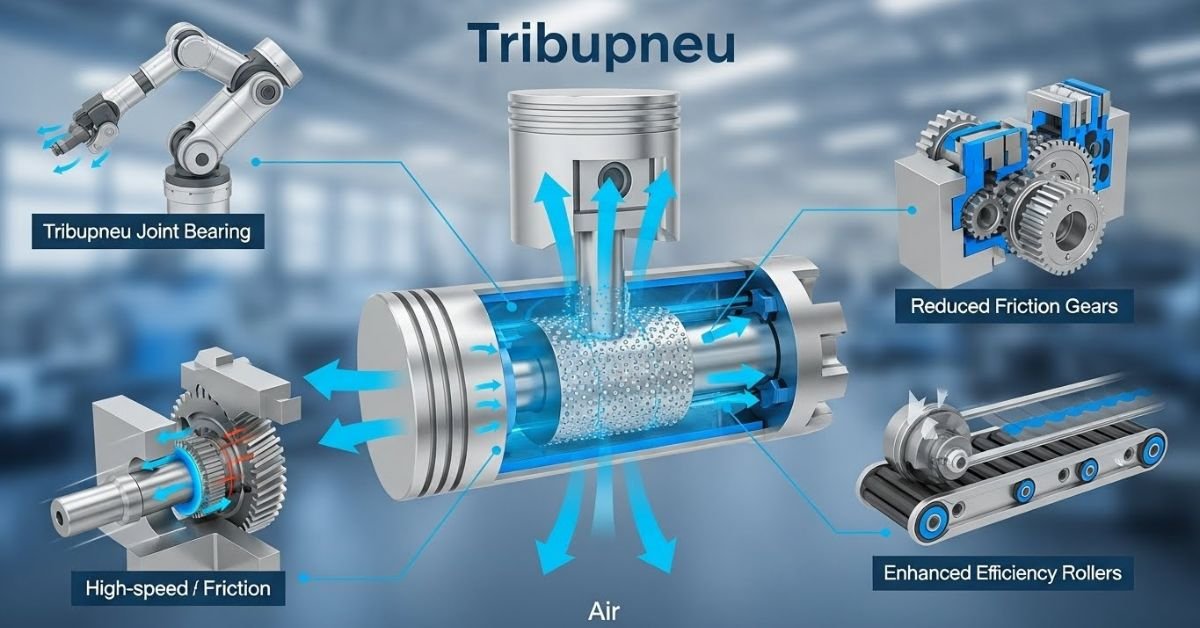
Tribupneu technology is revolutionizing several sectors by replacing outdated methods. When applied to the field of automobile engineering, its novel lubrication procedures optimize engine performance, leading to greater fuel efficiency and less pollutants.
Aerospace companies may save a lot of weight and make their parts last longer by using tribupneu. Both the aircraft’s performance and operational expenses are enhanced as a consequence.
This technique is also useful in manufacturing. When it comes to precision machining, tribupneu solutions are the way to go for a more seamless experience and extended tool life.
Also included is healthcare. In order to make medical operations more comfortable for patients, researchers are looking into using these technologies in medical devices that have low friction requirements.
Utilizing tribupneu’s distinct characteristics, many industries tackle distinct problems and strive for ever-increasing levels of efficiency and sustainability. Because of its applicability, this technology is an intriguing subject for ongoing research in many other domains.
Advantages and Limitations of Using Tribupneu
The many benefits of tripneu make it a promising material for use in contemporary engineering. It changes the game with its capacity to boost efficiency. Components may last longer with less maintenance because to this technology’s ability to reduce friction and wear.
On top of that, these systems are often small and light. This makes it possible to incorporate it into preexisting machinery with little to no change or modification. Another notable aspect is the adaptability of tribupneu in many sectors.
Nevertheless, one must take into account the constraints. It may be out of reach for smaller businesses due to the expensive initial installation expenses. Aside from that, operators who aren’t aware with the technology’s specific capabilities could need to undergo specialist training.
The materials employed in tribupneu systems also provide a hurdle, as they may not function optimally in all situations. For effective implementation, it is crucial to ensure compatibility with varied industrial situations.
Future Possibilities and Developments
Tricopneu has a bright future ahead of it. Machine learning and artificial intelligence, when combined, have the potential to completely alter the way technology is used. Envision systems that can anticipate when maintenance is required and execute it accordingly, drastically reducing downtime.
Future innovations also place a premium on sustainability. In an effort to lessen their impact on the environment without sacrificing performance, scientists are looking at eco-friendly materials.
Cooperation with the robotics and automation industries is another promising new path. By working together, we can improve mechanical systems and make them more resilient to harsh environments.
Tricopneu technologies are becoming more adaptable as industries progress. There will certainly be new uses for renewable energy and transportation, which will lead to innovation in many fields.
Research and development investments will keep pushing toward breakthroughs, ensuring tribupneu’s place in current engineering landscapes. Unlocking even bigger possibilities ahead, pioneers are pushing limits, and the horizon seems optimistic.
Conclusion
As we go more into the fascinating realm of tribupneu, we can see how this engineering method is changing many different markets. This technology has come a long way from its beginnings, with its foundations firmly planted in cutting-edge scientific concepts. It improves efficiency and performance in a variety of domains where it is used.
Reducing friction and increasing durability are two obvious benefits of tribupneu that may enhance operational performance and save a lot of money. Nevertheless, like with any new technology, there are certain limits that will need to be resolved in the future.
The future seems bright in terms of the realm’s potential. There may be even more revolutionary developments in the near future, according to current research and developments. Potentials that were previously considered impossible might be unlocked via the discovery of new materials and procedures.
Tricopneu is at a fascinating crossroads in engineering right now, thanks to its combination of retro and modern elements. We may expect further innovations that will improve our technology environment for a long time to come as specialists keep working in this area.