

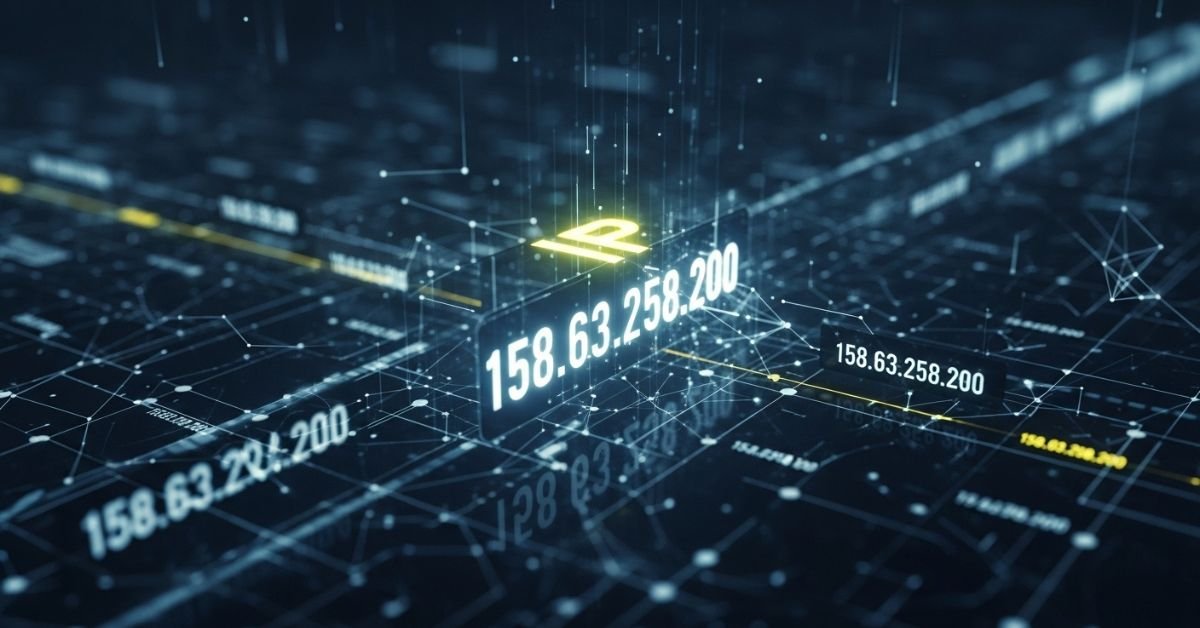
Do you remember a time when you came across an IP address and couldn’t understand it? As an example, consider the seemingly mundane string of digits 158.63.258.200 and how profoundly significant they are in the vast digital cosmos. If you’re into technology or simply want to know more about the internet, learning about IP addresses is a must.
In this article, we will examine the format used to identify devices on networks, the many sorts of IP addresses, and their actual meaning. The most pressing issue that needs addressing is whether or not 158.63.258.200 is indeed legitimate. Come along as we explore these enigmas and deepen your understanding of a foundational component of internet communication!
What is an IP Address?
Every electronic item that can be accessed over a network is given a distinct identity known as an IP address, which stands for Internet Protocol. Imagine it as a digital version of your physical address; it helps data navigate the enormous internet.
In order for your device to connect with other devices, it needs its IP address whenever you send an email or visit a website. This guarantees that data does not be corrupted or lost while in route.
The Internet Protocol has two major variants, IPv4 and IPv6. The former is simpler and can handle the increasing number of connected devices, while the latter is more complicated and has four sets of integers separated by dots.
If you’re interested in networking or cybersecurity, you really must learn how IP addresses operate. When it comes to technologically linking our world and enabling smooth communication across many platforms, they are crucial.
The Basics of IP Addresses
Internet Protocol addresses are fundamental for online communication. They act as distinct identifiers for all of the devices that are part of a network, just like a person’s home address does.
An IP address is necessary for any device that can connect to the internet. Therefore, it is able to send and receive data efficiently. Data would be lost without these addresses.
With IPv4 format, an IP address is a series of integers separated by periods; with IPv6, it is a larger string of alphanumeric characters. Structured data on the network’s location is intended to be conveyed.
Users may better fix connectivity difficulties and increase their cybersecurity awareness by understanding how IP addresses function. Mastering these fundamentals will pave the way for further exploration of more advanced networking subjects.
Types of IP Addresses
In the digital realm, IP addresses are classified into many groups, each with its own specific function. Both public and private IP addresses are the most common kinds.
No two public IP addresses are ever the same. With their help, gadgets may talk to one another online. One of these is required for correct identification of any web-connected device.
In contrast, local networks make use of private IP addresses. These offer advantages in both residential and business security and administration, and they aren’t routable on the internet.
Differences between static and dynamic IP addresses are another kind. Because they never change, static addresses are perfect for hosting servers and websites. Assigned by DHCP servers, dynamic ones are subject to frequent alteration in order to maximize allocation of resources.
Maintaining network efficiency and facilitating seamless communication across platforms and devices are the responsibilities of each kind.
Understanding the Format of IP Addresses
To better identify devices on a network, IP addresses follow a specified format. Typically, they have four groups of numbers with periods between them. For each set, the possible values are 0–255.
The most popular variant of this setup is known as IPv4. As an example, 192.168.1.1 is one possible format for an IP address.
Additionally, IPv6 was added to support the increasing number of devices connected to the internet. It substitutes colons for periods and offers eight sets of hexadecimal digits.
In order to avoid any potential network misunderstanding, the architecture guarantees that each device has its own unique address. If you want to fix connection problems or configure your network settings correctly, you must understand this format.
Data packets traversing the enormous internet rely on each segment to direct them to their intended destinations.
Is 158.63.258.200 a Valid IP Address?
We need to look at the structure of 158.63.258.200 to see whether it is a legitimate IP address. With a value between 0 and 255, each of the four octets makes up an IPv4 address.
Examining the provided sequence, we see that three octets—158, 63, and 200—fit comfortably inside this range. Nevertheless, 258 is contained in the second octet.
This renders the IP address invalid since no segment in IPv4 format may be greater than 255.
In order to be used for routing purposes in a network, an IP address must closely follow certain numerical bounds.
Even if a lot of numbers appear the same at first glance, only those that follow certain restrictions may be used in digital communication networks.
Reasons Why An IP Address May Not Be Valid
An IP address could become invalid due to a number of things. Missing formatting is a major contributor. The address 158.63.258.200 has parts that are too long.
An IPv4 address can only have integer values between 0 and 255 for each segment. When this restriction is exceeded, even by a single digit, the entire address is rendered useless.
Conflicts inside networks may also cause problems. When devices on a local network attempt to interact with each other, they may encounter connection issues due to the presence of duplicate IP addresses.
No one device may be allocated a certain IP address since certain of those addresses are reserved for specific protocols or uses.
When there are temporary changes to the network infrastructure or settings, an address that another device was using before may no longer be valid, which can happen with dynamic IP assignments.
Conclusion
Clarity is paramount when trying to make sense of IP addresses. Network devices are able to interact with one another thanks to IP addresses, which act as unique identifiers. In order to handle the ever-increasing quantity of devices that may connect to the internet, two main varieties of these addresses have been developed: IPv4 and IPv6.
The purpose of these numerical strings can be better understood by delving into the format. For IPv4 addresses, the standard format consists of four octets, with each octet containing a value between 0 and 255.
Coming back to the original point, 158.63.258.200 deserves our full attention. Due to possible mistakes or formatting difficulties, not all sequences fall inside legal IP address parameters.
Since one of its components is more than the maximum permissible value (255), the dissection shows that this specific string fails inspection. Thus, while delving into such numerical details might yield valuable insights, it is equally essential to identify instances when something falls short of technical requirements.
If consumers are familiar with the components of an IP address, they will have a much easier time overcoming network issues. If people really understand these ideas, they will be far more prepared for any digital challenge that comes their way.